
When it comes to search optimization, nothing can frustrate a marketer more than Google playing peek-a-boo with your client’s position. You can do everything by the book, and still be punished for it. It’s not you; it’s Google. WEBPRO is known for helping local and national brands expand their footprint, but it’s getting harder, and it takes more time to rescue clients from ad spend. I still contend clients can cost-effectively build brand recognition with organic placement, rather than draining their marketing budgets on PPC or other Pay-per-Click initiatives.
Organic conversion rates are significantly higher, with the cost per touch as high as 73 to 74 percent. Whether the target audience is B2B or B2C, Forrester Research estimates that 84 to 85 percent will rely on organic listings because the “trust factor” in natural listings is higher. However, when opening a new brick-and-mortar business that depends on foot traffic, PPC may be warranted. In fact, necessary. But under close supervision.
I mentioned in my book that I’m not a PPC purist. Although I see it as a double-edged knife, don’t discount the fact that PPC can be a good pry bar in your toolbox.
The numbers don’t lie
The data backing organic search keeps getting louder, even as Google tries to turn down the volume. The number one organic result captures roughly 39.8% of all clicks. The top three results together pull more than two-thirds of every click on the page. And page one overall? Nearly 97% of all clicks happen within the top ten organic results. Virtually nothing reaches page two.
WordStream reports that only about 6% of clicks on Google go to paid results. The other 94% go organic. Studies consistently show that 70 to 80 percent of users skip ads entirely, trusting organic results more. That’s not a marginal difference. That’s a mandate.
After 12 months, organic search becomes 5 to 10 times more cost-effective than paid search for the same traffic volume. The total cost of ownership over 24 months runs 40% lower than PPC for equivalent traffic. That’s the math that matters when you’re talking about a marketing budget that has to perform, not just spend.
PPC is a rental. Organic is equity.
The PPC trap
Organic first-page placement helps put a face on a great service or product with more credibility. Google’s Pay-Per-Click console is impressively complex, intimidating, and confusing; most people who attempt to use it become frustrated, give up, and just roll over. That’s not my idea of a win.
Unless you have someone who is intimate with Google Ads and knows how to interpret relevant keyword phrases for placement and bidding using their tools, a company needing quick results will more than likely be disappointed. Going organic is healthy for any company regardless of budget.
Google’s average cost-per-click hit $4.66 in 2024, and it’s only gone up. In competitive industries like legal, insurance, and home services, a single click can run $15 to $50 or more. You’re paying for a click, not a customer. Not a lead. A click. And Google’s fine with that, because they get paid whether the click converts or not.
The moment you stop paying, your traffic goes to zero. Rankings you build organically keep delivering traffic tomorrow, next month, and next year without another dollar spent on ad placement. That’s not theory. That’s how we’ve operated for 32 years.
Mobile changes everything
Redesigning a website for mobile takes careful planning. Don’t take this initiative lightly. Just because you have a responsive website doesn’t mean it’s mobile-friendly. All collateral materials and digital assets need to be rated for sizzle as well as practicality when targeting mobile users. WEBPRO uses a design theory for maximum impact.
All development needs to take place in a structured environment for testing and approval before launch. Since Google indexes mobile compliance first, SEO is appreciated differently from a desktop marketing point of view.
Don’t launch your mobile design experiment on a production server where Google can index it prematurely. If implemented incorrectly, you stand to lose any hope of first-page placement.
Google moved to mobile-first indexing years ago. That means the mobile version of your site is what Google evaluates for ranking, not the desktop version most business owners are staring at when they approve a redesign. If your mobile experience is slow, cluttered, or hard to navigate, Google sees a bad website. It doesn’t matter how polished it looks on a 27-inch monitor.
What it looks like when it works
Here’s what organic-first placement looks like in practice, across three very different clients in three very different industries.
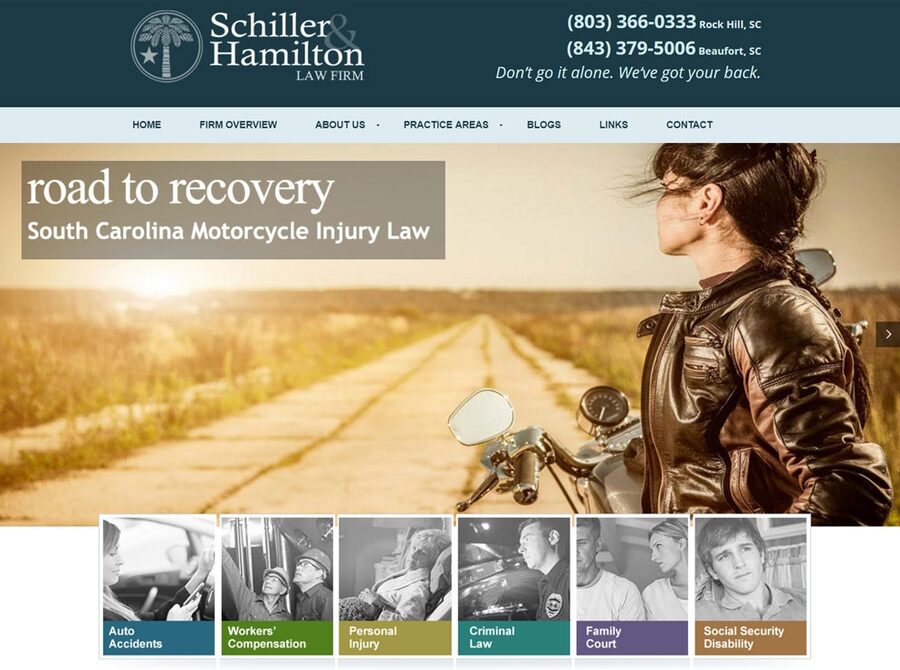
The legal industry is one of the most brutal arenas for search placement. Law firms throw enormous budgets at Google Ads, and the cost-per-click for terms like “auto accident lawyer” or “personal injury attorney” can exceed $100 in major metros. What we did with Schiller & Hamilton was prove that a well-built site with proper on-page structure and disciplined content strategy could outperform firms spending ten times the budget on paid clicks. This firm consistently appeared on Google’s first page well beyond its immediate geography, which is rare anymore because of the saturation points on the Google Map Pack. The trust factor in an organic listing for legal services can’t be overstated. People searching for a lawyer after an accident aren’t clicking the ad. They’re scrolling past it.
 #1
#1 Tabata Orthodontics sat in one of the most competitive dental markets in the country. Southern California is saturated with orthodontic practices, and the Google Map Pack only shows three. We built the site from scratch with mobile-first indexing in mind, and the result was a #1 Map Pack position, all organic. No PPC. The practice grew so fast it became a competitive threat in its own market, and Dr. Tabata was eventually bought out. That’s not a marketing footnote. That’s organic search turning a two-location practice into an acquisition target. The site we built didn’t just rank. It grew the business to the point where someone had to write a check to stop competing with it. For what comes after first-page placement in orthodontics — which social channels to turn once the site earns position one — see the companion piece, Which Social Dial Do They Turn?.
The proof at scale
 #1
#1 “WEBPRO has kept us 100% organic for years, saved us over $780,000 in online marketing, and we still compete with companies spending millions.”
A. Hilliard, President of the Carolinas, Texican Natural Gas
Let that number register. $780,000 saved. Not spent. Saved. And Texican isn’t competing against local shops. They’re going head-to-head with Piedmont, Scana Energy, BP, Constellation, Colonial Energy, and 14 other natural gas suppliers, many of them backed by marketing budgets that could fund a small company for a decade. Texican shows up first, organically, because the site was built right and the SEO was done right from day one.
It’s important to appreciate that these aren’t hypothetical case studies with blurred-out names and vague metrics. These are real clients, with real sites, on the real first page of Google. Whether you have a local search listing issue or a national campaign, we can assuredly help keep you compliant and found.
So if organic is this powerful, why is Google making it harder?
Everything above is the case for organic done right. The data is clear. The client results are undeniable. Organic placement builds equity, earns trust, and delivers better conversion at a fraction of the cost.
But Google has been systematically eroding the tools that make organic placement work. And they’ve been doing it quietly, incrementally, in ways that most business owners never notice until their traffic disappears.
Between January 2025 and January 2026, organic click share dropped between 11 and 23 percentage points across every major vertical. Paid results captured double the click share in the same period. Position one lost nearly a third of its click-through rate. Position two lost almost 40%. AI Overviews now appear on roughly 31% of search result pages, pushing organic results below the fold.
And that’s just the visible part. Behind the scenes, Google has been rewriting the single most important on-page element a site owner controls: the title tag. The words you carefully craft to represent your page in the search results? Google throws them out and replaces them with whatever it decides the searcher should see instead.
<title>Affordable Kitchen Remodeling in Atlanta | Free Estimates | Peachtree Renovations</title>
<!-- Matching H1 reinforces the title -->
<h1>Atlanta Kitchen Remodeling Done Right</h1>
Atlanta Kitchen Remodeling Done Right
www.peachtreerenovations.com
We offer full kitchen remodeling services in the greater Atlanta area...
The keyword phrase “Affordable Kitchen Remodeling” is gone. The conversion driver “Free Estimates” is gone. Google still uses the original title tag for ranking, but the searcher never sees it. The marketer does the work. Google takes the credit for the presentation.
If organic placement is built on trust, relevance, and the marketer’s ability to control how a page appears in search, what happens when Google takes that control away?
Coming in Part 2: When Google Rewrites Your Words
Google started rewriting your title tags in 2021. By 2026, the same page can display a different title for every searcher. In Part 2, I’ll show you exactly how they do it, what it costs you, and how a 5-store Bojangles franchise used organic strategy to outshine its own corporate office. That Bojangles story is already on the record in Which Social Dial Do They Turn?, the companion to this series on organic-first placement.