
In the AI era, you don’t rank.
You get cited.Answer engines don’t hand your buyer ten blue links anymore. They write the answer, and name a source. We create the content that becomes that source.
WEBPRO writes content engineered for the way ChatGPT, Perplexity, Gemini, and Google’s AI actually work: content they can read, trust, and quote by name.
Answers reflect responses generated by Grok (x.ai) to questions about WEBPRO, reproduced for illustration. AI answers vary by query and change over time. FCC ACP figures are from public FCC data.
WEBPRO Research · The Vanishing Click
The parent asks. The machine answers. Your practice never gets the click.
A parent thumbs in best braces for my kid. Google answers on the page. They never click, and the practice that could treat that child may as well not exist. That is the vanishing click, and it is measured, not predicted: 68% of US searches now end without one. Two forces decide how fast it climbs. Pull them.
How readily engines answer on the page instead of sending a click. Higher closes the garden.
How often burned users click through to check the answer. Higher pulls clicks back.
- By 2030, no click
- ...
- Clicks per 1,000 searches
- ...
Share of searches ending without a click
Reaching the open web, 2030 (was 374 in 2024)
Anchored on measured data: 68.01% of US Google searches ended without a click in early 2026, up from 60.45% in 2024 (SparkToro / Datos / Similarweb clickstream). Open-web clicks fell from 374 to 276 per 1,000 searches in two years. The curve bends with the gap between the two dials; it does not invent a number it cannot source. Directional, updated quarterly. Story: Scroogled, p.84, “The Orthodontists Who Beat the Box.”
See if AI answers name you, or your competitor →The acronyms that replaced “just rank on Google.”
Search didn’t die. It split. Buyers now ask machines, and machines answer from sources they trust. Here’s the language of that shift, in plain terms.
Structuring content so an AI engine can lift a clean, correct answer straight from your page, and credit you as the source when it responds to your buyer.
Writing for the generative models themselves (ChatGPT, Gemini, Claude, Perplexity) so your business shows up inside the answer they generate, not just the links beneath it.
Still the foundation. Rankings, crawlability, and authority haven’t stopped mattering. They’re now the ground AEO and GEO are built on, not the finish line.
Shaping how the models “understand” your brand (the entities, facts, and relationships they associate with you) so they describe you accurately and favorably.
Google’s AI-generated answer box (now AI Overviews) that sits above the classic results and often ends the search before a link is ever clicked.
The credibility signals engines weigh before they’ll quote you. We build them into every page: real expertise, cited clearly, from a source worth trusting.
The through-line: every one of these comes down to the same thing: being the clearest, most trustworthy answer to the question your buyer is actually asking. That’s what we write.
We can’t make you the answer until we understand the question.
Generic agencies bolt keywords onto boilerplate. We do the opposite. We go deep on how your business actually makes money before a single word gets written. It’s a real sequence, and we don’t skip steps.
Immerse
We sit with your team, your sales calls, and your best customers to learn what you sell, who buys it, and the exact words they use when they’re ready to spend.
Interviews & intakeModel
We map your business model (margins, service lines, geography, buying triggers) so content targets the questions that actually lead to revenue, not vanity traffic.
Business-model mapWrite
We create answer-ready content: structured, factual, entity-rich, and matched to real buyer questions, engineered for engines to quote and humans to act on.
Answer-ready pagesProve
We track where you get cited, which answers you own, and what converts, then keep expanding the questions you’re the source for, month over month.
Citations & resultsGoogle doesn’t grade your page. It hunts your cluster.
In June, Search Engine Journal surfaced a Google research paper describing the Scalable Cluster Termination System (S-CTS). The paper studies video spam and frames the system as research, not a confirmed web-search switch, but the architecture tells you everything you need to know.
It doesn’t read trillions of pages one at a time, grading each on merit like a patient teacher. It hunts for clusters. It groups accounts by infrastructure signals and inorganic behavior, the fingerprints left when a pile of sites share the same scripts, the same API keys, the same templated output on the same mechanical schedule. When it spots that lazy signature across a network, it doesn’t quibble over individual pages. It terminates the whole cluster at once. Not the page. The cluster.
This isn’t new. Panda did the same thing in 2011. Hundreds of sites sharing identical templates and the same publishing schedule looked like a single spam network to Google’s eyes, and broad-brush enforcement caught the lazy, the negligent, and sometimes the merely trusting in the same sweep. The full story is in Scroogled.
S-CTS reported by Search Engine Journal, June 2026. The paper addresses video-platform spam; application to web-search ranking is inferred from the architecture, not confirmed. Figures are Google’s own, over a six-month window.
Content built to be quoted, not just found.
Every piece is written to do double duty: earn the citation from the answer engine, and earn the phone call from the human who reads it.
Answer-Ready Pages
Pages structured around the precise questions your buyers ask, with the answer stated cleanly up top where engines lift it and readers scan it.
Entity & Schema Content
Structured data and entity-rich copy that tell the models exactly who you are, what you do, and why you’re credible, in a language they parse natively.
Comparison & Buyer-Question Pages
The “best,” “vs,” and “how much” pages that AI answers pull from constantly, written to put you inside the recommendation.
Authority & Pillar Content
Deep, genuinely useful resources that establish the expertise engines require before they’ll trust you enough to cite you by name.
Local & Service-Area Content
Location and service-line pages that make you the obvious local answer when someone asks an engine who to hire in your area.
Ongoing Content Governance
Standards and refreshes that keep every page accurate, current, and citable, because an engine’s trust is earned continuously, not once.
Thirty-one years reading how search, and now AI, picks its answers.
We’ve written content through every major shift: directories, PageRank, mobile, featured snippets, and now generative answers. The tactics change; the principle doesn’t: the business that explains itself most clearly and credibly gets chosen.
What sets us apart isn’t a content mill. It’s that we learn your business well enough to write like we work there, then engineer every page to be the source the machine trusts.
Questions decision makers ask
Generative Engine Optimization is the practice of optimizing your brand and content for visibility inside AI-generated answers produced by large language models and generative search experiences, so your business appears in the responses users increasingly rely on instead of a traditional results list.
The terms overlap heavily. AEO emphasizes winning direct, often-cited answers to specific questions; GEO emphasizes broad brand visibility and representation across generative AI outputs. WEBPRO treats them as complementary parts of one AI-search strategy.
As more people get answers directly from AI tools, appearing in those generated responses becomes as important as ranking in classic search once was. Brands absent from AI answers lose visibility they may not even realize they're missing.
Through clear entity definition, authoritative and factual content, structured data, and consistent brand information across the web, so models can accurately identify, trust, and represent your business. WEBPRO builds these signals deliberately.
You can't directly control an AI's output, but you can strongly influence it by shaping the authoritative, structured, consistent information it learns from. WEBPRO works to improve the accuracy and favorability of how AI represents your brand.
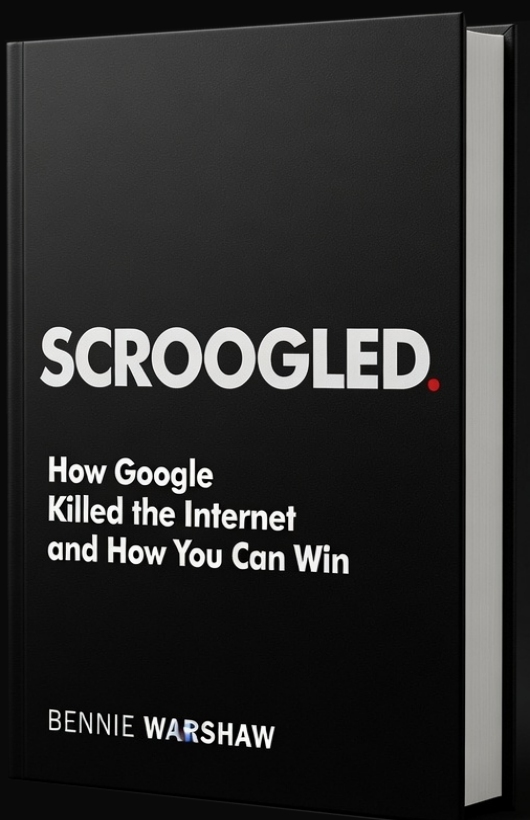
Scroogled.
In 2024 Google quietly blew up 31 years of SEO with one product move called AI Overview. Instead of sending people to your site, Google now answers their questions itself and keeps the traffic, the attention, and the money.
WEBPRO CEO Bennie Warshaw has spent 31 years on the front lines of search. He breaks down exactly what happened, who got hurt, and what you need to do right now.
The AI Overview Takeover. How Google’s AI-generated answers pushed organic results aside overnight and what that means for every website owner.
30 Years of SEO, Rewritten. The rules that drove traffic for three decades got quietly thrown out. Here’s what actually works in the post-search era.
Who Really Pays the Price. Small businesses, publishers, and independent voices are the hidden casualties of Google’s pivot to AI.
What Comes Next. A clear roadmap for surviving and thriving when the search engine you built your business on stops sending traffic.
Find out which answers
you could already own.
The content audit is free. We’ll show you the buyer questions AI engines are answering without you, and exactly what it takes to become the source they cite.
Get a Free Content Audit