
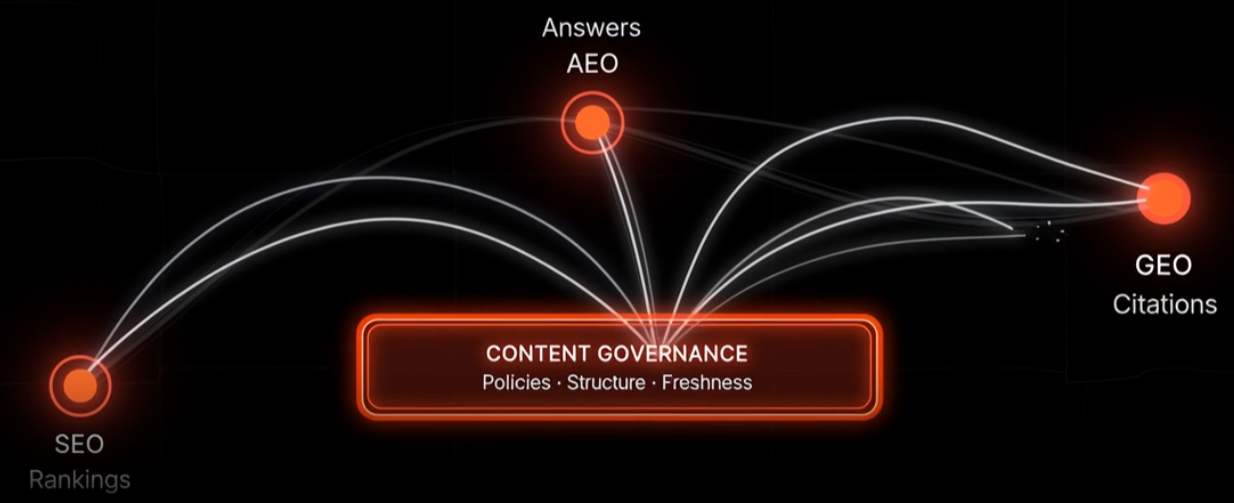
One great page won’t save a site full of drift.
Content governance is just having a clear system for your website’s pages instead of winging it. It answers simple questions: who owns each page, what “good” looks like before it goes live, who approves it, when it gets updated, and when it’s time to take it down.
Without it, you end up with a pile of random pages that slowly go stale and contradict each other. With it, every page stays accurate and works together, so Google and AI tools trust your site and keep pointing people to it.
SEO, AEO, and GEO want three different things from the same page.
Across SEO, GEO, and AEO this matters more than most teams admit. SEO still needs crawlable pages, solid technical foundations, and trustworthy signals so engines can rank you. AEO needs clean, extractable passages and clear structure so the same content can surface as a direct answer in snippets, voice results, or AI Overviews. GEO needs content that’s citable, fact-dense, and entity-clear so generative systems actually pull from it and name the source when they synthesize an answer.
Without governance those three goals pull against each other. The result is content that ranks poorly, never gets extracted, and never gets cited.
What strong governance actually does.
It keeps the whole stack aligned and turns content from a series of one-off assets into a controlled system that compounds authority. Instead of hoping each writer remembers the rules, the rules are built into how every page gets made.
Answer-first, entity-clear
Forces consistent structure and entity language so the same page can serve traditional rankings, answer engines, and generative citations at once.
Freshness, enforced
Builds in refresh rules because AI systems quietly drop sources that feel outdated. Your facts stay current and your pages keep getting pulled.
E-E-A-T, not hoped for
Enforces real authorship, primary data, and third-party corroboration through the system, instead of hoping individual writers remember.
No cannibalization
Prevents keyword cannibalization and thin content that quietly erode your standing across every surface you’re trying to win.
Teams that treat governance as optional discover the cost later.
It rarely fails loudly. It fails the way drift always does, slowly and then all at once. Rankings drift. AI citations favor competitors who kept their facts current and their structure clean.
One page written by one person in 2022, another by a freelancer in 2024, another spun up by a plugin last month, each following its own rules or none at all. By the time the rankings slip and the citations dry up, years of inconsistency have already piled up.
The brands that stay visible across search, answer engines, and generative results in 2026 are the ones that made content governance non-negotiable from the start.
Killed the Internet
and How You Can Win
Scroogled™.How Google Killed the Internet and How You Can Win
One change, AI Overview, undid three decades of how search sent people to websites. Google now answers on its own page and keeps the click, the attention, and the money. After 31 years in search, I wrote this to explain what changed, who it costs, and what to do about it.
The AI Overview Takeover. Google now answers at the top of the page instead of linking to the sites that wrote the answer. What that did to your traffic, and why it happened so fast.
30 Years of SEO, Rewritten. Most of the old playbook was built for a search engine that no longer works that way. What still earns clicks, and what quietly stopped.
Who Really Pays the Price. The traffic did not vanish; it got absorbed. Where it went, and why small businesses and publishers feel it first.
What Comes Next. A working plan so your business keeps getting found even when search stops sending people your way.
Find out which answers
you could already own.
The content audit is free. We’ll show you the buyer questions AI engines are answering without you, and exactly what it takes to become the source they cite.
Get a Free Content Audit →