
You know the joint. Cracked vinyl stools held together with duct tape. A griddle nobody’s scraped since the last administration. Flypaper in the window doing steady business. It’s the kind of counter you don’t sit down at. You take one look through the glass and you keep walking.
That’s the shop that cooked this orthodontist’s first website.
The greasy spoon
They served it the way places like that always do. Same menu as every other booth in the chain, a new name painted on the sign, and a bill like it came out of a steakhouse. The practice ate it anyway. Then it walked out.
The practice shut that kitchen down. Scrapped the menu. The site got torn to the studs and rebuilt from the ground up: new pages, new structure, a new address for everything. Clean kitchen. Real food.
Then the email showed up.
There’s nothing worse than tasting a bad meal, and a bad decision, twice.
The belch
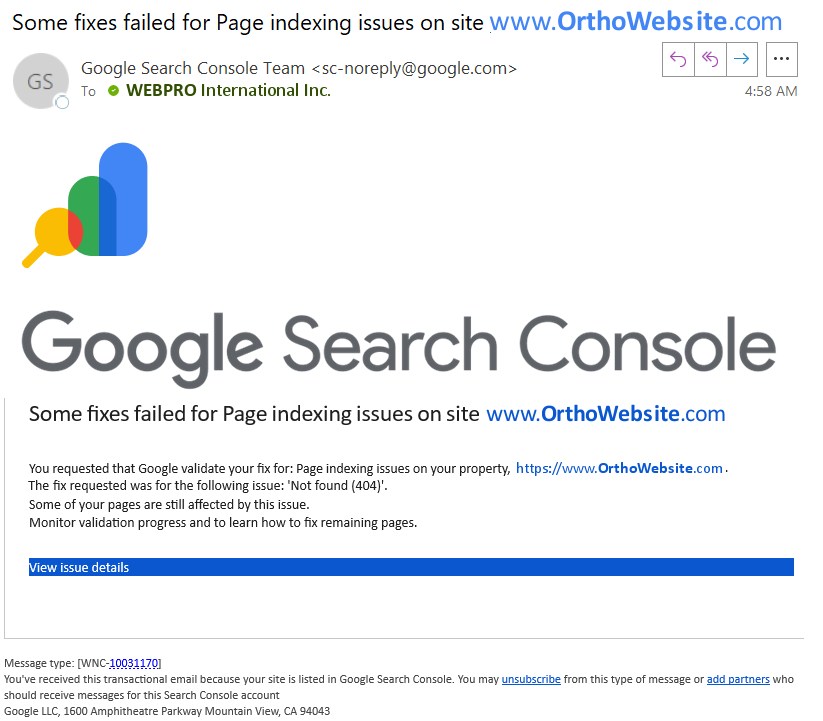
Read it the way the front desk reads it. Some fixes failed. Some of your pages are still affected. It sounds like the building’s on fire. And it doesn’t just land on the webmaster’s desk. Search Console mails everybody on the account, so the office manager gets it, and the doctor gets it. Now somebody’s forwarding it with three question marks, and somebody else is losing an hour explaining a meal nobody in the building cooked. If time’s money, this harmless little email comes with a check.
If you’ve read When Google Cries Wolf and its sequel, you know the routine. Take the starch out of it and here’s what it actually says.
Somebody clicked Validate Fix on the 404 report. Google went back to the old addresses, found them still empty, and called that a failure. That’s the health inspector writing you up because the diner you bulldozed still isn’t serving breakfast. A 404 on a page you buried on purpose isn’t an error. It’s the right answer. Google’s own people said years ago that 404s on pages that don’t exist won’t hurt the rest of your site. The email just doesn’t bother mentioning it.
But a belch is the meal coming back up, and it’s the gift that keeps on giving. You’re ten miles down the road, windows down, and here it comes again. Google spent years crawling that old greasy menu. It memorized every page. So months after the kitchen went dark, it keeps wandering back to the empty steam trays looking for yesterday’s special.
Who cooked this
So I went back to see what was on the old menu. The report behind that email is the receipt: 25 addresses Google says it can’t find. Read the page names and you can smell the kitchen.
/office-visits
/office-tour
/for-all-ages
/retainer-instructions
/patient-forms
/damon-smile
/invisalign-treatment
/meet-dr-[doctor-name]
/blog/.../st-patricks-day-celtic-pride-green-shamrocks-and-lucky-charms
Those aren’t one practice’s page names. They’re a vendor’s. The old site’s pages carry Sesame 24-7’s page names. Sesame Communications is the dental and orthodontic website shop now owned by Internet Brands, and its sites sign off with the same footer line: Website Powered by Sesame 24-7. As it turns out, they come with the same menu, too.
Sesame runs a demo site for an orthodontist who doesn’t exist. Dr. Samantha Sesame. Her toll-free, local, and fax lines all read 555-555-5555. Her navigation carries /office-visits, /office-tour, /for-all-ages, /retainer-instructions, /patient-forms, /damon-smile, and /invisalign-treatment. Same slugs as the ghost list. One kitchen, a lot of signs.
And it isn’t only the page names. Pull up the Emergency Care page on Sesame-built sites in Bowie and Severna Park, Maryland. Philadelphia. Harrisonburg, Virginia. Greenville, North Carolina. Billings, Montana. Chandler, Arizona. Las Vegas. Then the demo. Here’s the opening line on every one of them.
[practice] Bowie, MD /emergency-care
[practice] Severna Park, MD /emergency-care
[practice] Philadelphia, PA /emergency-care
[practice] Harrisonburg, VA /emergency-care
[practice] Greenville, NC /emergency-care
[practice] Billings, MT /emergency-care
[practice] Chandler, AZ /emergency-care
[practice] Las Vegas, NV /emergency-care
ortho.drsesame.com/emergency-care # the demo
> "True orthodontic emergencies are rare, but when they occur we are available to you."
Word for word. Comma for comma. Eight real practices in three time zones and a cartoon one, and not one of them wrote that sentence.
The dental side of the house gets its own recipe. Sesame-built dentists in Prosper, Texas; Kent, Washington; Los Alamitos, California; and Cortlandt Manor, New York all open their emergency page with the same line: “If you experience a dental emergency, be sure to call our practice as soon as possible.” Same second sentence, too. And on a Prosper page about when kids should start treatment, the copy says early visits make it “easier for the us to diagnose.” The same paragraph on a Sesame site in Arizona says “easier for the orthodontist.” Somebody swapped one word for another and nobody read what came out. That’s what reheating looks like up close.
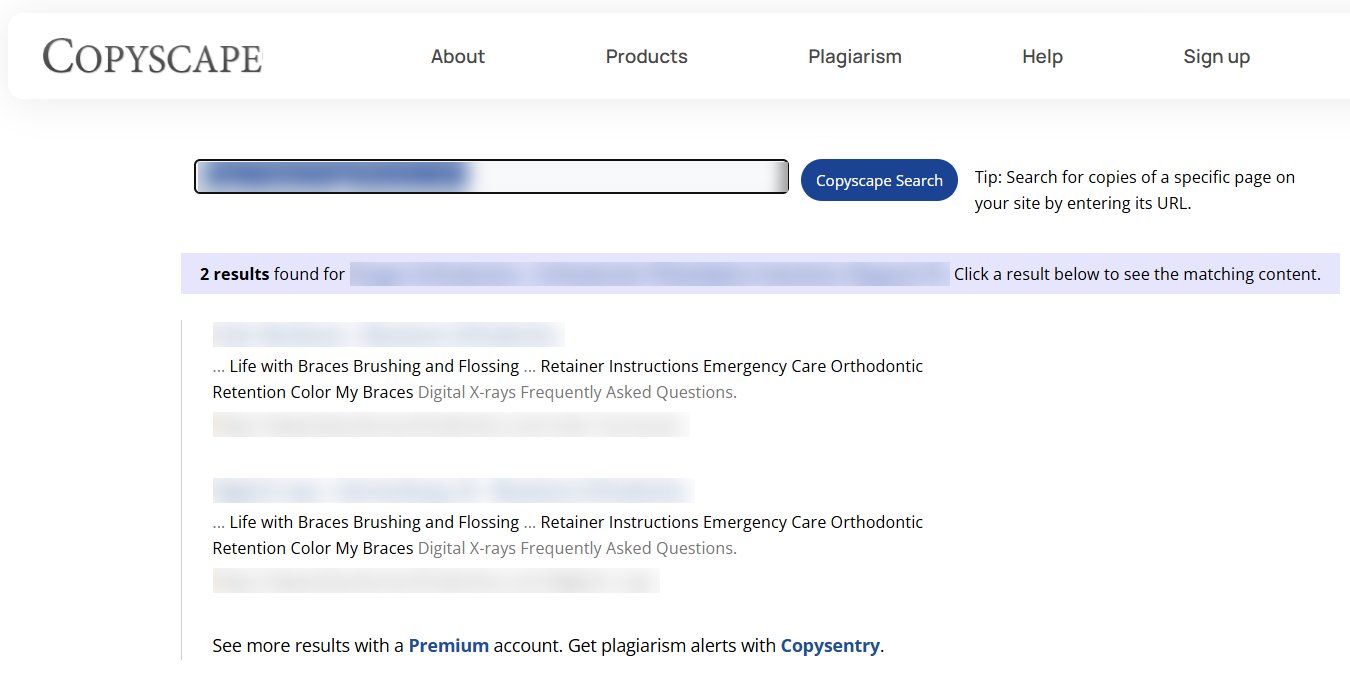
Want a second opinion? Run almost any template-built practice site through Copyscape, the plagiarism checker, and you’ll find its twins. I ran a Philadelphia practice’s site. Even the free scan turned up a practice in Harrisonburg, Virginia, wearing the same menu word for word, right down to Color My Braces. Different state, different doctor, same kitchen. That isn’t a menu. That’s a franchise.
And here’s the part that stings. None of those doctors chose that copy. It came with the package. They’re getting held back for something they never knew they bought.
The blog was no better. Three of the ghost URLs are old blog posts. One’s the St. Patrick’s Day number up top: Celtic pride, green shamrocks, and lucky charms. Search that title and you’ll find the same post parked on practice sites all over the country, served by more than one vendor. Canned seasonal filler, reheated every March and plated like it’s the chef’s special. Lucky charms, all right.
Past the expiration date
I’ve watched this movie before. In February 2011 Google rolled out Panda, and it went straight after thin, duplicated, mass-produced pages. Sites built on warmed-over copy got spanked, and plenty never came back. I watched law firms eat that one, because their template shops had stamped the same pages across client after client. FindLaw was the name everybody knew in that business. I wrote about it in Chapter 5 of Scroogled, “The Template Trap: How FindLaw Burned Law Firms.”
Here’s the punchline. In December 2024, Thomson Reuters sold FindLaw to Internet Brands. Same roof that owns Sesame. You can’t make this stuff up.
Google told everybody what it wanted fifteen years ago. Original pages. Real expertise. Copy that belongs to the business publishing it. A vendor still shipping one menu to orthodontists all over the country is serving a meal that should’ve been pulled off the shelf when Panda showed up. Practices are still running it today, and still making the run to the pharmacy.
You can change the label on the can. It’s still the same can.
Reading the receipt
Here’s the whole check, sorted. Nothing on it says the new site is broken. Most of it says somebody else’s leftovers are still in Google’s memory.
| # | What's on the plate | Examples | What we do |
|---|---|---|---|
| 11 | Old menu pages that have a new home | /home, /office-visits, /retainer-instructions, /invisalign-treatment | 301 each one to the page that replaced it |
| 5 | Canned posts and leftover filler | 3 reheated blog posts, /hello-world/, the old /sitemap | 410. Gone for good. Quit asking. |
| 8 | Not pages at all | Patterns with asterisks in them, theme folders, a Cloudflare email script | Leave them alone |
| 1 | Already answering | The new blog page, which loads fine today | Nothing. It clears on the next crawl. |
The 11 that matter get routed one by one, each to the page that actually took its place.
/retainer-instructions 301 → /patients/retainer-care/
/invisalign-treatment 301 → /treatments/invisalign/
/damon-smile 301 → /treatments/braces/
/office-tour 301 → /about/our-office/
/request-consultation 301 → /contact/request-appointment/
/blog/.../st-patricks-day-... 410 # expired
Notice what’s not on that list. The homepage. Not one dead page gets shoved at the front door. I’ll get to why in the next one.
Who dealt it
Here’s what I’d tell any front desk that gets this email. Nothing’s wrong with your site. Google’s tasting a meal somebody else cooked, and it’ll keep tasting it until the old addresses are routed or retired. We don’t panic. We don’t mash the Validate button. And we don’t sweep every dead page onto the homepage and call it a day. That’s wiping the counter and walking out. Google treats that move as a soft 404, and the ghost is right back on the report in six months.
At some point you stop white-knuckling the wheel and reach for the Rolaids. That’s us. A proper 301 for every old page that earned a successor. A 410 for the leftovers that never should’ve been served. A sitemap that only lists what’s actually on the menu. Then we leave the dead stuff dead. It’s the same discipline behind our Indexability Scoring: Google’s read of a site gets better when the noise goes away, not when you paint over it.
He who smelt it, dealt it. Except Google didn’t deal it, and neither did the new site. Those ghost addresses came off the old template’s menu. The 404 is the correct answer. The alarm is just Google still tasting the onions.
The Google Cries Wolf series / When Google Cries Wolf / Wolf. Wolf. Wolf. Wolf. / Tasting a Bad 404 Twice