
Every few months a measurement vendor drops a report about AI search, a marketer reads the four bullets in the launch email, and that’s as far as anyone gets. The bullets travel. The pages underneath never do. So this time I opened the pages. Similarweb’s 2026 Generative AI Landscape report runs 38 pages, and I went through it the way I’d go through a client’s log files, line by line, checking the summary against the chart it claims to summarize. The report isn’t a fraud. It’s something more ordinary, and more worth understanding. It’s what you get when the summary is written for engagement and the chart is written for accuracy, and nobody in the room is paid to reconcile the two.
I’ll show you what I found, page numbers included, so you can pull the PDF and check me. That’s the whole point of this exercise. If I’m going to accuse a report of selling certainty it doesn’t have, I’d better not do the same thing.
The number that changed when nobody was looking
Start with app downloads, one of the five big numbers on the summary page. When the report launched on July 22, PPC Land quoted the summary as 2.7 billion downloads, up 134% year over year. Search Engine Journal repeated the same figures eight days later. Meanwhile, the chart on page 6 of that same document showed 4.4 billion downloads against 2.8 billion the year before, which is 58%. Two pages, two answers, one metric, and the difference between them is the difference between “AI apps more than doubled” and “AI apps grew about as fast as AI websites.”
Then the number quietly changed. The PDF you can download from Similarweb today reads 4.4 billion and 58% on page 2 and on page 6. Somebody fixed it. Nobody said so. There’s no correction line, no revision date, no footnote. The version everyone quoted is still the one in circulation, and the version on the site is the one anyone opening it today will cite. Both of them are “the report.”
One metric, three readings, page numbers in hand
Gen AI app downloads,Jun 2025 to May 2026
Summary page at launch, per PPC Land and SEJ, 2.7 billion, up 134%
Page 6 chart, same document, 2.8 billion to 4.4 billion, up 58%
Summary page today, 4.4 billion, up 58%, no correction notice
The summary got fixed. The screenshots didn’t.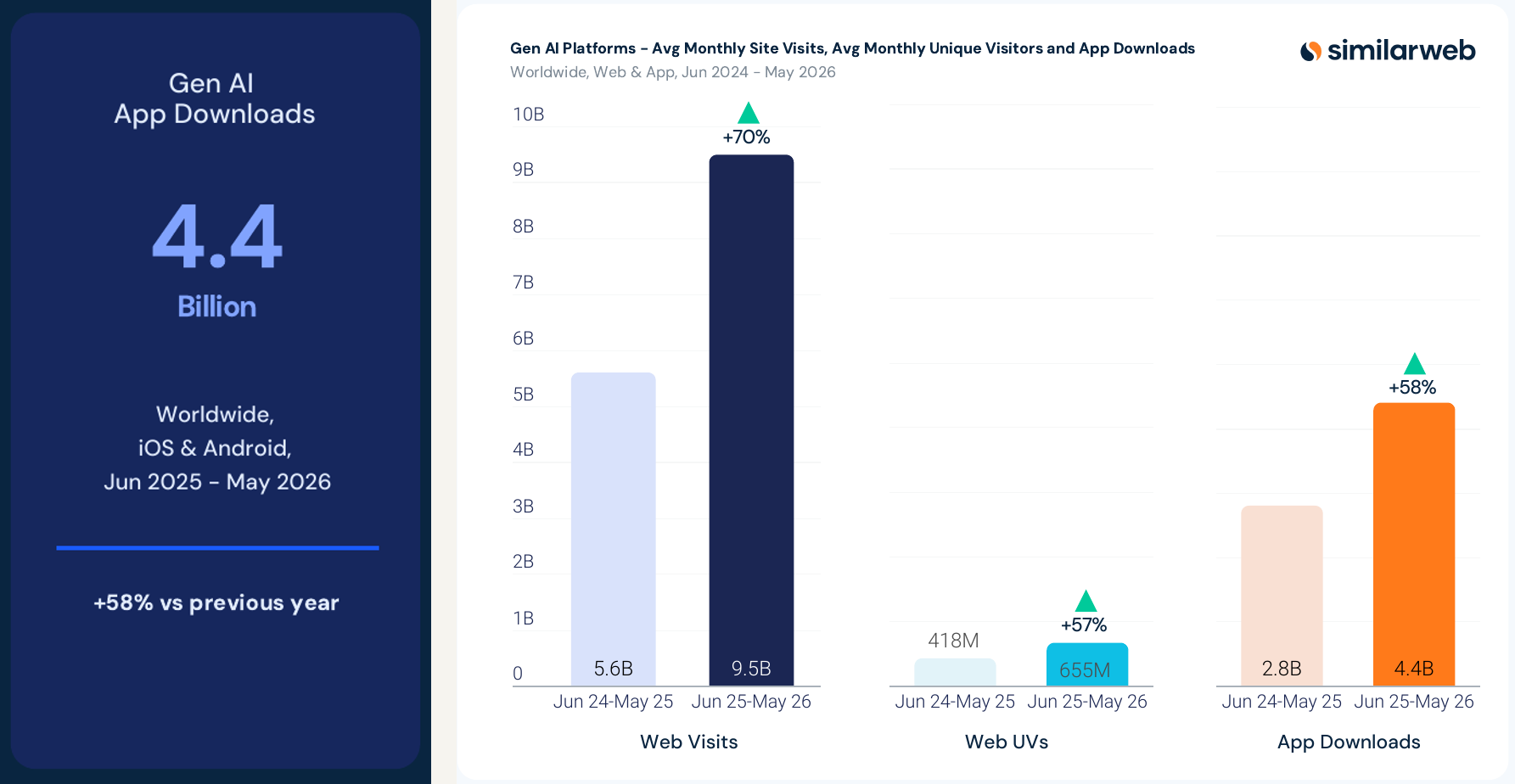
I want to be fair about what this is and isn’t. Nobody had to lie for that to happen. A summary card gets drafted from an early data pull, the analyst updates the chart, the card doesn’t get the memo, and it ships. I’ve seen it in agencies, in newsrooms, in my own shop. The problem isn’t the mistake. The problem is that a 134% growth figure ran through the industry for a week with the vendor’s name on it, and the fix arrived silently, which means the marketers who built a slide on the wrong number will never know.
The summary is the part that travels. The chart is the part that’s right.
One statistic, three definitions
The report’s headline advertising number is 26%. That’s the share of ChatGPT activity that now carries an ad, and it’s the figure that got the most pickup because it’s the newest thing in the deck. Here’s the trouble. Page 2 calls it 26% of ChatGPT chats. The chart on page 31 measures the share of ChatGPT conversations containing ads. Page 35, the report’s own glossary, defines ad penetration as the percentage of ChatGPT responses that include at least one sponsored result. Similarweb’s own blog uses that third framing.
Chats, conversations, and responses aren’t synonyms. A chat with eight responses and one ad is 100% on the chat ruler and 12.5% on the response ruler. I don’t know which one Similarweb actually measured, and after reading every page, neither do you. The number is real. What it’s counting is left as an exercise for the reader.
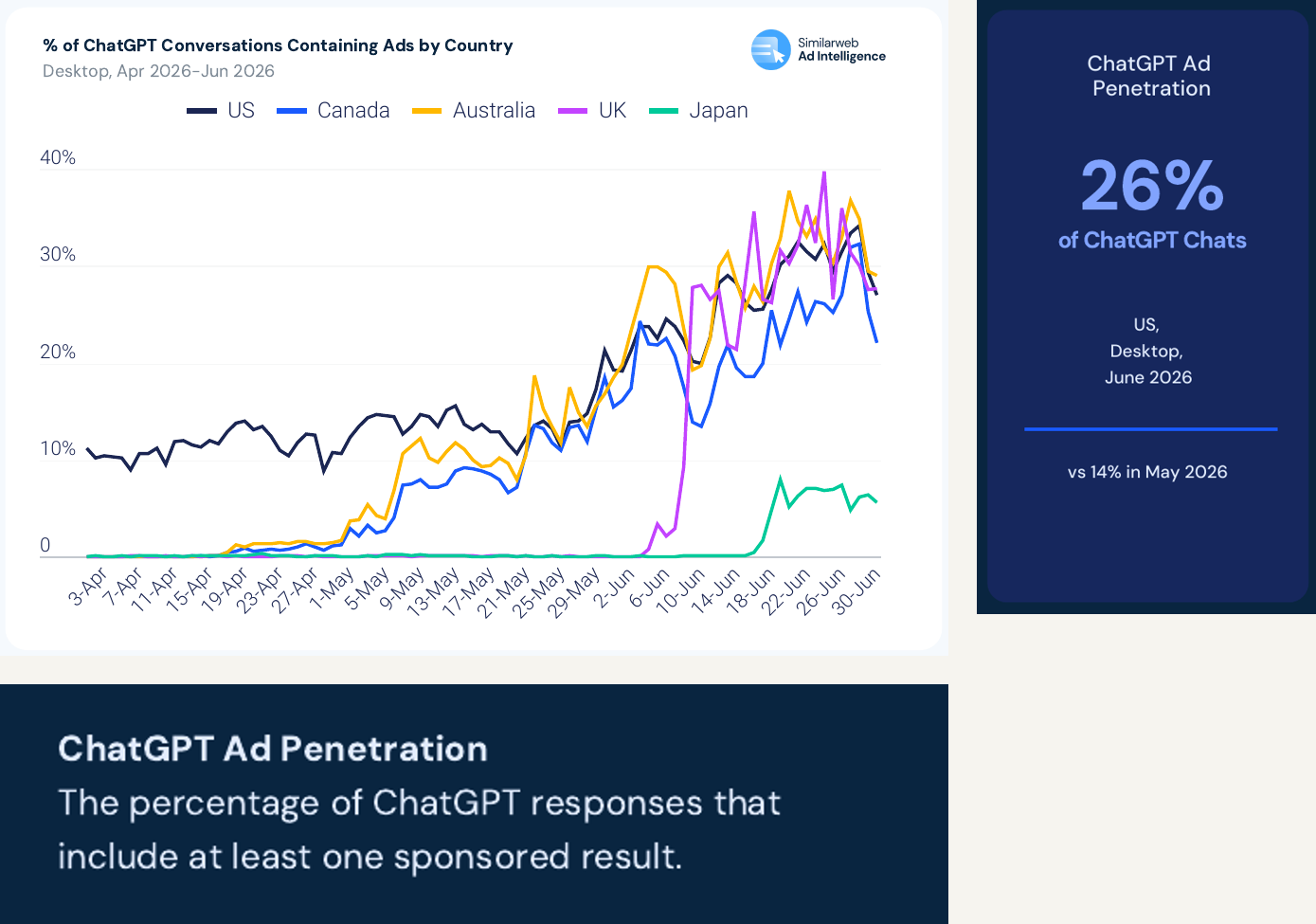
A statistic without a fixed denominator isn’t a measurement, it’s a headline. When the summary, the chart, and the glossary each describe the same 26% differently, the report has told you it doesn’t know either.
Two rulers, one market
Now put a second measurement firm next to the first. Adthena sells the same kind of intelligence Similarweb sells, and in July it published its June 2026 numbers for the same surfaces. Adthena recorded Google AI Overviews in 18% of US searches and 23% of UK searches. Similarweb’s page 10 chart shows US AI Overviews above 40% in the same month. Adthena also recorded zero ChatGPT ad placements across 169,560 UK scrapes in June, a 0.00% frequency rate. Similarweb’s page 31 chart shows UK ad penetration climbing above 30% in that same June.

Two firms that sell measurement for a living described the same market in the same month and produced answers that can’t both be true. Neither has published enough methodology to settle it. Different panels, different denominators, different collection methods, and no third party grading either of them. That’s not a scandal. That’s the actual state of the channel, and it’s exactly the thing the marketing collateral papers over with a confident summary card.
Pick your ruler before you pick your number.
The missing remedy
My sharper criticism isn’t about the arithmetic. It’s about what the report tells you to do once you’ve absorbed it. Page 33 is the “Looking forward” conclusion, and the advice for brands comes to four items. Build a recognized brand. Earn trust. Create authoritative content. Maintain an omnichannel presence. That’s 1994 advice, and I know because that’s the year I started this company. It was true then, it’s true now, and it isn’t worth 38 pages.
I counted three “Book a live demo now” buttons, on pages 18, 29, and 38. I counted one actionable instruction, and it didn’t come from Similarweb. It came from Lily Ray of Amsive, on page 27, in a guest passage. She points out that every major AI search product relies on retrieval-augmented generation, meaning the model pulls live content from search indexes before it writes an answer. If your organic position slips, your AI position follows, because the model can’t retrieve what it can’t find. That’s the whole answer, sitting on page 27 of a report selling a new measurement category. The new era runs on the old fundamentals.
When a company sells you the diagnosis and the monitoring subscription, and the treatment plan is four sentences everyone already knew, you should ask what you actually bought. The one useful sentence in the deck was written by an outside consultant.
I’ve seen this movie
In Scroogled I spent a chapter on the meta description tag, the little summary you write to tell Google what your page is about. For years Google rewrote it anyway, at rates the industry measured at 60% to 70%. Then in October 2025 Google started testing Gemini-written descriptions in place of publisher copy. Complete sentences. Fluent, confident, and not yours. Fluency arrived and accountability never did.
That’s this report. A marketer reads four confident bullets in an email and never opens the pages underneath. The summary consumed the demand for the source. Similarweb published an answer box about answer boxes and got caught by the same physics that catches everyone else. It also rhymes with the last thing I added to the book before it went to print. Google rolled out cluster enforcement in the spring of 2026, and I compared it to Panda in 2011. In both cases the machine grades the pile, not the page. The confident summary gets treated as the truth about everything underneath it. The remedy in both cases is the same. Own your pages. Know what’s on them. Don’t let anyone else’s summary stand in for your own reading.
My own number, and where it came from
I’m not going to critique other people’s forecasts and hide mine. In December 2025 I told colleagues that AI-assisted results would show up in 60% of US searches before the end of 2026. I put it in writing in February 2026. At the time, Similarweb’s own page 10 chart had US AI Overviews in the mid-30s, after a spike to 40% in August 2025 and a fall back to 27% that October. Google was turning the dial up and down, and I said 60% anyway.
The same chart shows where the line went next. AI Overviews sat near 13% of US searches in June 2025 and reached 42% to 43% by May 2026, roughly 30 points in eleven months. Hold that pace and you’re at or near 60% by December. I stand by the call. But here’s the part that matters more than whether I’m right. It’s my planning assumption for client work. It’s judgment, not measurement. I don’t run a panel, and I’m not going to dress an opinion up as data. That distinction is the entire point of this article. And for the record, it’s stated on Similarweb’s ruler. On Adthena’s, the same figure was 18% in June. Pick your ruler first.
What it looks like when you do the work
Everything above is just commentary unless I can show you what the old fundamentals do in the new era. WEBPRO supports close to thirty orthodontic practices around the country right now, and orthodontics is about as exposed to AI answer boxes as a vertical gets. Somebody asks a chatbot for the best orthodontist near them and the answer box eats the click. So we do the boring things. Uniquely written page-level copy, no templates. Hand-written per-page JSON-LD schema instead of a site-wide plugin. FAQ schema at depth. Google Business Profiles we manage directly instead of leaving to the front desk.
One fourteen-location group grew from 14,070 to 25,700 unique monthly visitors over five months, an 83% increase, with every location appearing in both the map pack and page-one organic results. They still compete with Gemini every day, and so does everyone. The click is smaller than it was when the internet was honest. But smaller and gone are not the same word.
Lily Ray’s page 27 isn’t a theory. It’s the mechanism. Get retrieved and you get cited; get cited and you get the shortlist. The report spends 37 pages measuring the effect and one paragraph on the cause. Work on the cause.
The short account of these findings is AI Search Reports Are Selling Certainty the Industry Doesn’t Have. The same habit of selling a confident summary shows up in the claim that AI will slow down, which I take up in AI Over Easy.